



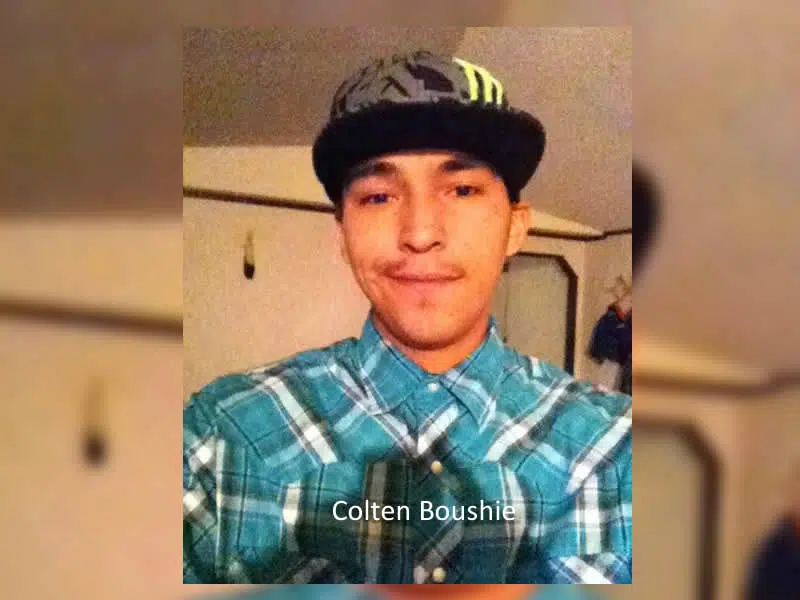
An independent agency that examines the conduct of RCMP is reporting they believe the RCMP racially discriminated against the family of Colten Boushie.
In a media release from Sunchild Law, portions of he Civilian Review Complaints Commission report say that RCMP fueled racial tensions in the wake of Boushie’s death.
The introduction of the CRCC’s report includes 14 points, beginning with the first contact between the police and Boushie’s family, as a source of much anguish, and insensitivity. According to the report a group of seven RCMP officers drove to the Red Pheasant First Nation reserve to notify Debbie Baptiste of her son’s death. The report says a search was conducted inside the home and claims not much context or information was given to the family. The Commission states RCMP members lacked lawful authority to search the home.
The report raised concerns regarding media releases from the RCMP media releases that resulted in “disproportionate focus on theft when discussing Mr. Boushie” and that the releases left the impression that Boushie’s killing was justified.
22 year-old Colten Boushie, was shot and killed in August 2016 after he and four others entered the property of Gerald Stanley’s property near Biggar.
The family of Colten Boushie will speak to the media regarding the matter on Monday, the full report was released Saturday Afternoon.
The “Introduction” of CRCC’s report relating to the family’s complaint against the RCMP states, in its entirety: (From Sunchild Law Release)
[1] Following the violent death of a loved one, the first contact between the police and the family can set the tone for an important relationship that will exist up until the completion of court proceedings and possibly beyond. For Colten Boushie’s family, this moment was unfortunately the source of much anguish.
[2] The first contact between the RCMP and Mr. Boushie’s family was on the night of August 9, 2016. After the RCMP initiated a criminal investigation into the death of 22-year-old Mr. Boushie, a group of seven RCMP members drove to the Red Pheasant First Nation Reserve to attend the residence of Debbie Baptiste, his mother, to notify her of her son’s death.
[3] The RCMP members surrounded Ms. Baptiste’s home, some with weapons at the ready. One of them notified her of her son’s death, and a number of the police officers then conducted a search inside her home while questioning the family members present. During the time they spent at Ms. Baptiste’s home, one or more RCMP members questioned Ms. Baptiste about her sobriety, smelled her breath, and looked inside her microwave to verify her statement that she had put her now-deceased son’s dinner there.
[4] After approximately 20 minutes, the police departed Ms. Baptiste’s home, leaving the family without much information or context in relation to Mr. Boushie’s death. That is until the RCMP disseminated its first media release the next day.
[5] The family had several concerns about this first contact with the RCMP, which led to a public complaint by Alvin Baptiste, Ms. Baptiste’s brother. The complaint focused mostly on the conduct of RCMP members who attended Ms. Baptiste’s home, but it also raised concerns about the media releases disseminated by the RCMP following Mr. Boushie’s death, and with a vehicle pursuit conducted while a young woman was in custody in the back seat.
[6] The RCMP initially investigated and issued a report in response to the complaint. The RCMP concluded that all of the family’s allegations were unsupported, except for the allegation about the safety of the young woman in custody in the police vehicle.
[7] Following its review and investigation of the complaint, the Civilian Review and Complaints Commission for the RCMP (“Commission”) found that the evidence supported all of the family’s allegations. The Commission made five findings and three recommendations in an Interim Report (Schedule 1) issued on November 4, 2019.
[8] The Commission found that the manner in which the RCMP members conducted the notification to Ms. Baptiste on the night of Mr. Boushie’s death was insensitive. In a separate report following a public interest investigation (PII) also conducted on this matter, the Commission concluded that the RCMP members treated Ms. Baptiste with such insensitivity that her treatment was discriminatory.
[9] In its Interim Report about the family’s complaint, the Commission also found that the RCMP members lacked lawful authority to search Ms. Baptiste’s residence and that the family suffered emotional prejudice as a result of the RCMP’s search of the premises.
[10] The Commission further found that the manner in which the RCMP members surrounded and searched the home was not commensurate with a reasonable risk assessment or with appropriate cultural and compassionate considerations.
[11] Some of the RCMP members had explained that, in addition to notifying Ms. Baptiste of her son’s death, they were also searching for one of the youths who had been with Mr. Boushie at the rural farm property where Mr. Boushie was shot. Mr. Boushie and his friends had entered the property after their vehicle developed a flat tire. A confrontation with the property owner and his family had followed. Although it was clear that only the property owner had fired a weapon, killing Mr. Boushie, some of the RCMP members had information indicating that the youth they were looking for might be armed.
[12] The Commission observed that, in its report about the complaint, the RCMP made no mention of the law to justify its members’ approach, search, and treatment of Ms. Baptiste at her home. While the RCMP’s report qualified the situation as “unique,” the Commission found that this did not justify the RCMP members’ actions, and that the law and its application to the facts should have been part of the RCMP’s report.
[13] The Commission found that some of the RCMP’s media releases resulted in a disproportionate focus on theft when discussing Mr. Boushie. This caused anguish for the family because the releases could leave the impression that Mr. Boushie’s killing was justified or that his death was “deserved”—a narrative that immediately emerged on social media after news of the death came out, and fueled racial tensions.
[14] More than 14 months after the Commission issued its Interim Report, the RCMP Commissioner provided her response. The RCMP Commissioner accepted almost all of the Commission’s findings and recommendations, even proposing additional measures to address some of the issues identified by the Commission. However, the RCMP Commissioner adamantly disagreed with the Commission’s finding that the manner in which the RCMP members surrounded Ms. Baptiste’s home was unreasonable. Having considered the RCMP Commissioner’s response, the Commission reiterates its finding in its entirety for the reasons outlined in this report.
The CRCC went out of its way to comment on the RCMP’s reluctance to take responsibility for the manner in which they treated Colten’s family:
Surprisingly, despite generally accepting almost all findings and recommendations, the RCMP’s response said very little about the issues at the heart of this case, while devoting much attention to more minor and technical points about the few findings the RCMP disagreed with. These points often related to resources and logistical issues that were discussed at length, while the more important issues were often addressed with few words. In that sense, the response could be viewed as a missed opportunity for the RCMP to take responsibility for the manner in which Mr. Boushie’s family and friends were treated.