





A former Saskatchewan teacher now working elsewhere is urging the province to include funding for class complexity in the teachers’ contract, highlighting her experience of an attack by a Grade 7 student which left her seriously injured as a reason why it is needed. She was introduced with the pseudonym Shelby by Saskatchewan Teachers’ Federation President Samantha Becotte, to highlight the increase in violence in classrooms.
Shelby told reporters she walked out into the hallway to see what was happening and was attacked by the student, leaving her with a serious concussion, a broken nose and multiple bruises. She doesn’t blame the student. Instead, she blames the lack of funding for supports in the classroom, so students with complex needs can learn how to handle their emotions.
Shelby says she tried to go back to her school once the bruising healed, but it didn’t work, so she moved to a different school and co-taught a class, then moved to another province. She worked with her doctor and physiotherapist for three months to help with continued issues with her concussion and to this day, she still needs help with her anxieties about the classroom. It took her quite awhile to become comfortable in a classroom alone again.
Becotte says violent incidents like this are not isolated. In a survey of Saskatchewan teachers last year, 35 percent of respondents reported that they have experienced violence in school in the last five years. The STF’s contract proposal includes a confidential provincial reporting mechanism for incidents of violence or harassment against staff, as some other provinces have. Elected officials, the Government-Trustee Bargaining Committee and the Saskatchewan School Boards Association have all heard this request, but Becotte believes they don’t realize how much of a problem the growing violence is.
==
Additional Saskatchewan Teachers’ Experiences: Violence in the Classroom (names are pseudonyms)
Roman’s* Experience

A recently retired teacher, Roman, returned as a substitute to his local high school and sustained significant injuries, including a broken jaw. He was walking to his next class, carrying his laptop and a stack of student work. A student ran by him and Roman stopped to remind the student not to run in the halls. A second student then inserted themselves in the conversation and was confrontational. Roman asked the second student to step back. When the student didn’t, Roman asked again more assertively before turning back to the student who had been running.
Within moments, the second student attacked Roman. “He began pummeling me, striking me in the head and jaw several times. My glasses went flying on the floor, along with my left hearing aid,” says Roman. Roman was taken to the local emergency room for treatment. His jaw was broken in several places, including a compound fracture. Facial surgery was not available in his community. He waited for six days, in severe pain, for surgery in Saskatoon. His jaw was clamped shut for a month while the bones healed. This meant he was on a liquid diet and unable to speak due to restricted jaw movement and pain. He has nerve damage in his lips and jaw that makes eating, drinking and pronouncing words difficult. It is still too soon to know how much of this damage will be permanent. Roman has decided not to take on any further substitute teaching.
Roman believes more students are trying to cope with mental health problems, drug abuse and family issues than when he started teaching. In addition, the COVID-19 pandemic resulted in academic shortfalls and social isolation for many students. He says, “I don’t know how the needs of these struggling students can be met by classroom teachers. Additional funding is needed to provide professional assistance for these students trying to keep their ‘heads above water.’”
Mary’s* Experience
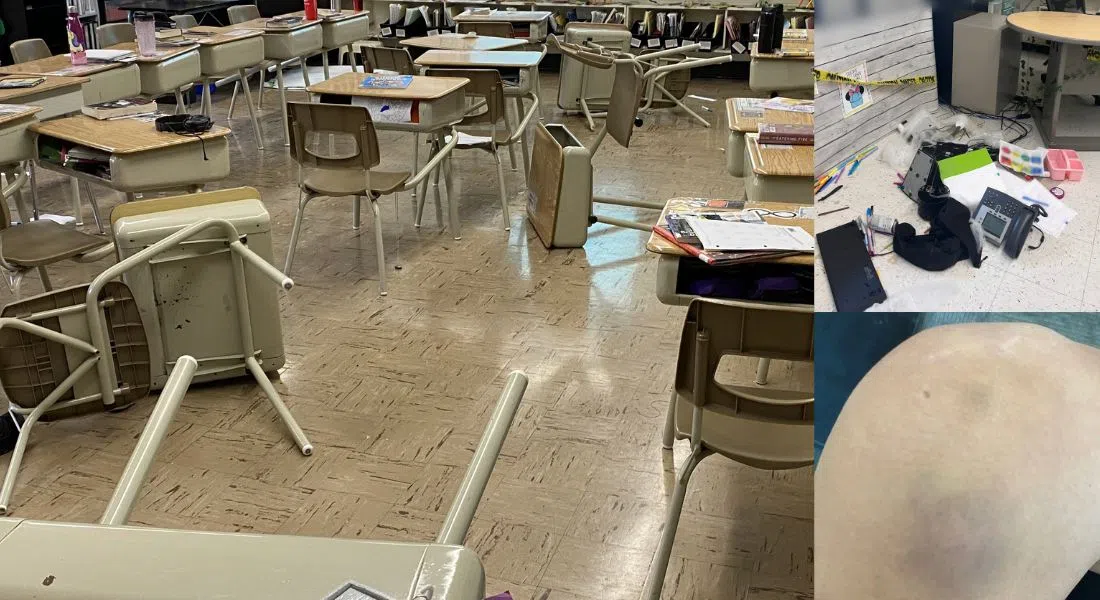
Mary is an experienced teacher of 17 years. She shares that students’ “inability to regulate has caused a lot of stress and violence at school that we are not equipped to deal with.” Mary has shared several instances of students who are dysregulated, running away into dangerous situations, throwing furniture, charging at her, and headbutting her and other staff.
When all strategies fail and the situation is no longer safe for the staff and students, staff are sometimes left with no choice but to restrain students. Mary emphasizes this is always a last resort and brings a significant emotional, physical and mental load for everyone involved. In one instance, Mary was struck by thrown chairs. In another, she was punched in the chest and the student tried to jab her with their pencil. “This behavior isn’t their fault. These students’ needs aren’t being met. They require and deserve more support than teachers alone can provide,” says Mary. “These things happen every day in our schools. It is traumatic and unacceptable for everyone: the students who are so dysregulated because they aren’t being given the supports they desperately need; the classmates who have to witness the event, evacuate the room and have their ‘safe space’ destroyed; and the teachers and other staff who are injured and put themselves in harm’s way to keep everyone safe and to try to help these students.”
Carla’s* Experience

Carla shares a story of dysregulation, where a student was taken to the school sensory room in hopes it would help them settle. The student removed their clothing, urinated and defecated on the floor before throwing and smearing fecal matter. Due to lack of space and underfunding in schools, the sensory room depicted shows overuse and lack of repair.