




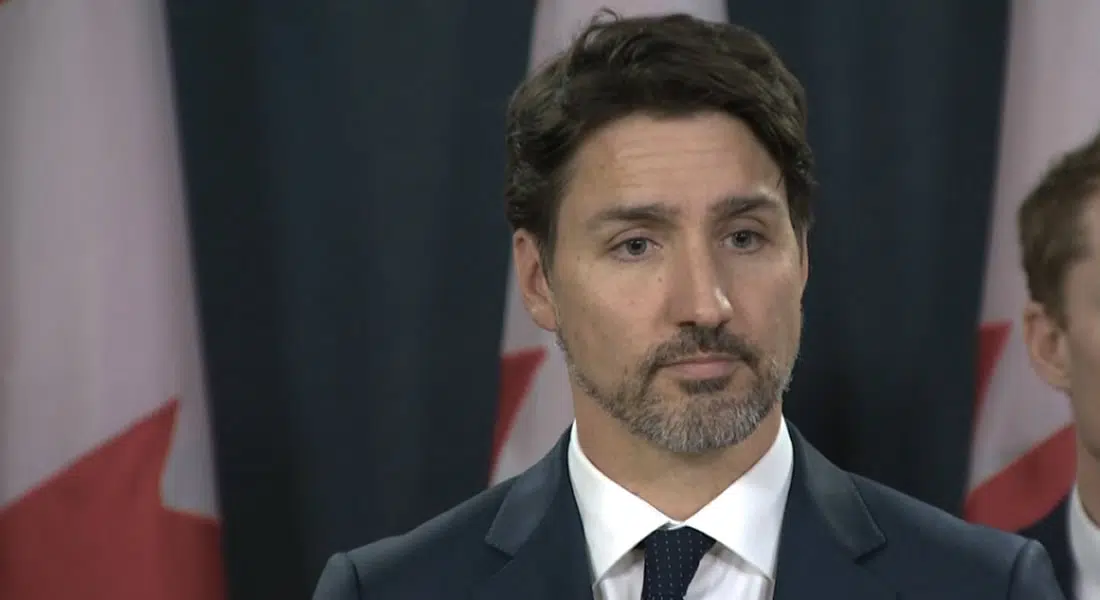
In coordination with President Donald Trump, Prime Minister Justin Trudeau announced today that Canada and the United States are temporarily restricting traffic across the Canada/US border and crossing for recreation or tourism will no longer be allowed. Trudeau notes that 2 billion dollars worth of goods crosses the border between the Canada and the U-S everyday and says essential travel will continue, that the decision will not impact supply chains.
The Prime Minister announced 27 billion dollars in direct support to workers and businesses during the COVID-19 economic crisis again urging people to work from home or to stay home, buying only what they need at the grocery store. There will be another 55 billion to meet liquidity needs, through tax deferrals, to help stabilize the Canadian economy. Combined, the 82 billion dollars is represents more than 3% of Canada’s GDP.
Trudeau says some Canadians don’t qualify for employment insurance and don’t have access to paid sick leave.
“Our government will introduce the emergency care benefit which will provide money every two weeks to workers who have to stay home. People can receive this benefit for 14 weeks to an amount comparable to what would be paid through EI.”
The benefit will apply to people who fall ill, those place in quarantine or people who have to self isolate as well as Canadians taking care of a family member with COVID-19.
If you lose your job and do not qualify for Employment Insurance, the Government of Canada is introducing a COVID-19 emergency support benefit. This applies to people who are self employed and have to close up shop because of the virus.
Prime Minister Justin Trudeau also announced that a measure is being put in place to encourage businesses to keep employees on the payroll during these uncertain times.
“We will provide employers of small businesses with a temporary wage subsidy worth 10% of salary paid to employees for a period of three months.”
Trudeau acknowledged that parents in Canada are going to find life challenging in this COVID-19 pandemic if not because of employment issues, then because of school closures and in some provinces, day cares so to take some of that pressure off, the government will temporarily boost the CCB in the coming months.
In addition to boosting the Child Care Beneft, in May the government is going to supplement those who get a GST cheque. Every adult who qualifies will receive $300 with $150 for every child.
Detailed description of support plans:
Support for workers
Provide additional assistance to families with children by temporarily boosting Canada Child Benefit payments. This measure would deliver almost $2 billion in extra support.
Introduce an Emergency Care Benefit of up to $900 bi-weekly for up to 15 weeks to provide income support to workers who must stay home and do not have access to paid sick leave. This measure could provide up to $10 billion to Canadians, and includes:
Workers, including the self-employed, who are sick, quarantined, or who have been directed to self-isolate but do not qualify for Employment Insurance (EI) sickness benefits.
Workers, including the self-employed, who are taking care of a family member who is sick with COVID-19, such as an elderly parent or other dependents who are sick, but do not qualify for EI sickness benefits.
EI-eligible and non EI-eligible working parents who must stay home without pay because of children who are sick or who need additional care because of school closures.
Introduce an Emergency Support Benefit delivered through the Canada Revenue Agency to provide up to $5 billion in support to workers who are not eligible for EI and who are facing unemployment.
Provide additional assistance to individuals and families with low and modest incomes with a special top-up payment under the Goods and Services Tax (GST) credit. This measure would inject $5.5 billion in the economy.
Waive, for a minimum of six months, the mandatory one-week waiting period for EI sickness benefits for workers in imposed quarantine or who have been directed to self-isolate, as announced on March 11.
Waive the requirement for a medical certificate to access EI sickness benefits.
Extend the tax filing deadline for individuals to June 1, and allow all taxpayers to defer, until after August 31, 2020, the payment of any income tax amounts that become owing on or after today and before September 2020. This relief would apply to tax balances due, as well as installments, under Part I of the Income Tax Act. No interest or penalties will accumulate on these amounts during this period. This measure will result in households having more money available during this period.
Provide eligible small businesses a 10 per cent wage subsidy for the next 90 days, up to a maximum of $1,375 per employee and $25,000 per employer. Employers benefiting from this measure would include corporations eligible for the small business deduction, as well as not-for-profit organizations and charities. This will help employers keep people on their payroll and help Canadians keep their jobs.
Provide increased flexibility to lenders to defer mortgage payments on homeowner government-insured mortgage loans to borrowers who may be experiencing financial difficulties related to the outbreak. Insurers will permit lenders to allow payment deferral beginning immediately.
In addition, to provide targeted support for vulnerable groups, the Government is investing to:
Reduce minimum withdrawals from Registered Retirement Income Funds (RRIFs) by 25 per cent for 2020 in recognition of volatile market conditions and their impact on many seniors’ retirement savings.
Implement a six-month, interest-free, moratorium on Canada Student Loan payments for all individuals who are in the process of repaying these loans.
Provide $305 million for a new distinctions-based Indigenous Community Support Fund, to address immediate needs in First Nations, Inuit, and Mtis Nation communities.
Support women and children fleeing violence by providing up to $50 million to women’s shelters and sexual assault centres to help with their capacity to manage or prevent an outbreak in their facilities. This includes funding for facilities in Indigenous communities.
Provide an additional $157.5 million to address the needs of Canadians experiencing homelessness through the Reaching Home program.
Support for businesses
Allow all businesses to defer, until after August 31, 2020, the payment of any income tax amounts that become owing on or after today and before September 2020. This relief would apply to tax balances due, as well as installments, under Part I of the Income Tax Act. No interest or penalties will accumulate on these amounts during this period. This measure will result in businesses having more money available during this period.
Increase the credit available to small, medium, and large Canadian businesses. As announced on March 13, a new Business Credit Availability Program will provide more than $10 billion of additional support to businesses experiencing cash flow challenges through the Business Development Bank of Canada and Export Development Canada. The Government is ready to provide more capital through these financial Crown corporations.
Further expand Export Development Canada’s ability to provide support to domestic businesses.
Provide flexibility on the Canada Account limit, to allow the Government to provide additional support to Canadian businesses, when deemed to be in the national interest, to deal with exceptional circumstances.
Augment credit available to farmers and the agri-food sector through Farm Credit Canada.
Launch an Insured Mortgage Purchase Program to purchase up to $50 billion of insured mortgage pools through the Canada Mortgage and Housing Corporation (CMHC). As announced on March 16, this will provide stable funding to banks and mortgage lenders and support continued lending to Canadian businesses and consumers. CMHC stands ready to further support liquidity and the stability of the financial markets through its mortgage funding programs as necessary. The Government will enable these measures by raising CMHC’s legislative limits to guarantee securities and insure mortgages by $150 billion each.